Dawn Phenomenon and Balancing Type 1 Diabetes While You Sleep
The biggest challenge for diabetics who use insulin is probably the night. What do diabetics need to do to sleep through the night, a quiet, calm and balanced night? And most importantly, how do they keep their blood glucose balanced, night after night?
Today we have the loop (a sensor that communicates with the pump so that together they keep blood glucose within range). Even with the loop, the night is a real challenge for anyone living with type 1 diabetes or any insulin-dependent diabetes. Balancing blood glucose during sleep can be even harder for diabetics who use injections and calculate their own basal insulin (like me).
By the way, the loop, like all pumps connected through a cannula in the skin, causes scar tissue at the insertion sites for many diabetics after years of use. Scar tissue that impairs insulin absorption is common among long-term pump users, and that’s exactly why I’ve been using injections for close to a decade (after about 15 years on a pump). But that’s a topic for another article.
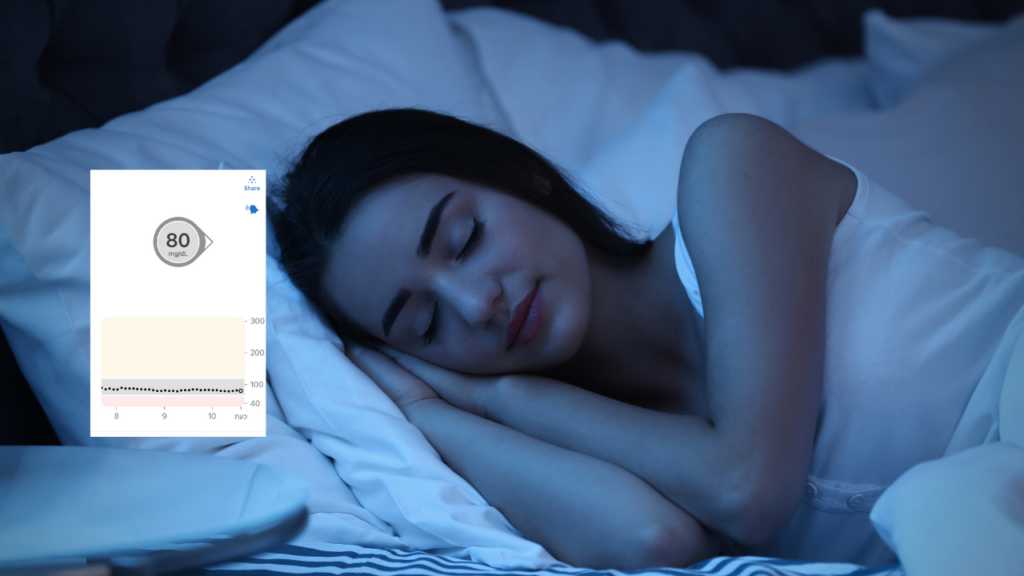
How Do You Balance Blood Glucose During Sleep, and What Does the Dawn Phenomenon Have to Do With It?
Any variation of a low-carb diet is the diet I guide every diabetic toward. It gives us predictable blood glucose, which lets us anticipate our levels throughout the day.
Take a sample day in which I aim for blood glucose within the truly healthy range (70–100 mg/dL for anyone, diabetic or not). That sample day brings us to an important topic: meal timing. Most long-time diabetics will tell you that when they eat in the first two hours after waking up, unexpected things happen to their blood glucose. The same is true for the four hours before bed. An ideal day is one in which we waited at least two hours before the first meal, and stopped eating at least four hours before bed.
That sample day leaves us with a window that starts two hours after waking and ends four hours before falling asleep. Every diabetic needs to test this for themselves. For some, the dawn phenomenon may end three hours after waking, or three and a half. At night, some may need to be more careful and stop eating five hours before bed to reliably avoid surprises overnight and in the morning.
Either way, this is our “eating window.” In short, we want to eat by the old saying: “Eat breakfast like a king, lunch like a prince, and dinner like a pauper.” Eat most of our food, and most of its volume, early in the day until around 3:00 PM. As the day goes on, reduce the volume and heaviness of meals (fewer carbs, and fewer meals that leave us feeling stuffed).

Meal Timing and a Sample Day to Prevent the Dawn Phenomenon
If we go to bed at midnight, our last meal should end by 8:00 PM. In the four hours before bed, we can snack on small, nearly carb-free portions, such as full-fat cheese or a very small amount of raw nuts. Pecans or macadamias, no more than five nuts, and only if our background insulin is too high and we want to temporarily “correct” the high dose with food until we find the perfect dose.
Finishing our last meal early also helps prevent the dawn phenomenon. It ensures that proteins and fats aren’t digested late at night, which would intensify the dawn phenomenon and cause blood glucose spikes the following morning.
When we wake up, we wait at least two hours. When the first hunger appears and starts to “tingle,” we start preparing for the biggest meal of the day. This meal should be large and satisfying and contain most of our daily food. If we rely on red meat, at 12:00 noon we might eat a 350 g (about 12 oz) ribeye steak with about half a cup of green salad, lightly seasoned with olive oil.
We continue our day and wait for the next hunger. If it shows up around 7:00 PM (and fits our schedule), we eat a small, less filling meal that makes up only a few percent of our daily food intake. An omelette with avocado made from a few eggs, enough to satisfy us without feeling stuffed, is an excellent choice for our last meal. We can inject a little insulin for it and continue into a predictable, calm night, assuming our basal insulin is accurate and keeps us in range, or that the loop is steering us into the normal range.
What Is the Dawn Phenomenon?
The dawn phenomenon is the release of glucose from the liver’s stores, caused by the body’s hormonal response to waking up in the morning (for those who wake up in the morning), which raises blood glucose in the morning hours. It’s a natural phenomenon that happens to everyone to some degree, regardless of diabetes.
The stress hormones behind this insulin resistance and blood glucose spike are also called “counter-regulatory hormones,” because their effect opposes that of insulin. The main hormones behind the dawn phenomenon are growth hormone (GH), cortisol, glucagon and epinephrine.
In non-diabetics whose pancreas works normally, the pancreas responds immediately to the dawn phenomenon by secreting insulin. A healthy pancreas easily handles the dawn phenomenon and prevents the damage of high blood glucose as well as possible. For us diabetics, we must be aware of the dawn phenomenon, know it well, and know how to prepare for it.
Some of the diabetics I work with in my programs add a dose of insulin (a bolus) in the morning because they know the dawn phenomenon is coming. The moment they open their eyes, they inject an extra bolus, and that’s how they prevent the blood glucose spike.
For diabetics who follow optimal balance in my programs, the dawn phenomenon usually balances itself over time, with consistency and attention to daily balance.
How to Prevent the Dawn Phenomenon
- Follow a very low-carb diet, 100% of the time. Stick with it and give it time.
- Avoid eating late, ideally up to 5 hours before bed.
- Eat the meat and your main meal at lunchtime. Make sure dinner, or the last meal of the day, is light.
- Keep a more or less fixed daily routine and relatively consistent sleep hours.
- Include regular movement or workouts to improve your body’s insulin sensitivity.
- Adjust medication and insulin doses to your schedule.
Don’t forget: there’s always a solution, and you can achieve balance in any situation, even with more complex conditions like the dawn phenomenon.
Go back to a specific part of the article: